
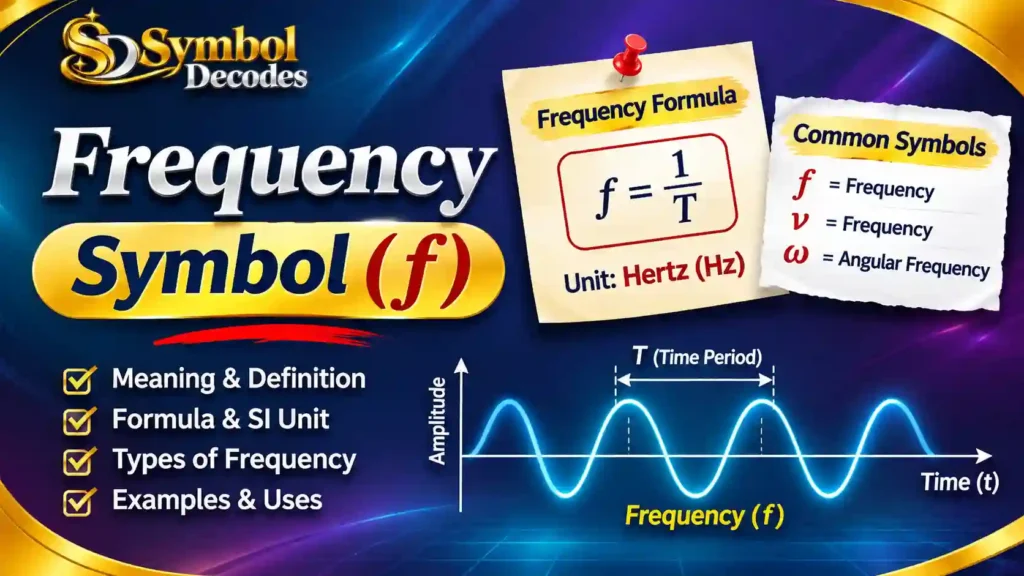
Frequency Symbol is a very important topic in physics that explains the rate at which a vibration or a wave repeats itself in a particular duration of time. Some of the commonly used symbols of frequency include the lower-case letter f and the Greek letter ν (nu).
It is important to know the frequency symbol because it makes the study of sound waves, light, electromagnetic waves, electric circuits, oscillations and many other periodic phenomena easy. Additionally, it enables students to understand the relationship between frequency, wavelength, and time period.
In physics, the SI unit of frequency is Hertz (Hz), where one hertz means one cycle per second. In this tutorial, you will learn everything about the frequency symbol, mathematical expressions, SI unit, applications, and solved problems verified for 2026.
What Is the Frequency Symbol?
The frequency symbol is a mathematical expression used to indicate the number of times an event or vibration repeats itself within a particular period of time.
In physics, the symbol for frequency is f. However, some scientists use the Greek letter ν (nu) in the study of spectroscopy and electromagnetic waves, among others.
For instance, if a vibrating body performs 50 oscillations in one second, its frequency is 50 Hz.
This implies that the frequency of the object is 50 oscillations per second.
The symbol for frequency is quite significant since it makes the scientific equations clearer and makes it easy to differentiate between frequency and other similar variables like time period and angular frequency.
What Is the Symbol of Frequency in Physics?
The widely used symbols of frequency in physics are f and ν (nu). The choice of symbol depends upon the branch of science.
| Symbol | Name | Represents |
|---|---|---|
| f | Lowercase F | Ordinary frequency |
| ν | Greek Nu | Ordinary frequency |
| ω | Greek Omega | Angular frequency |
| T | Capital T | Time period |
| Hz | Hertz | Unit of frequency |
| λ | Greek Lambda | Wavelength |
Important: The symbol representing a physical quantity and the symbol representing its unit are different. For example, f represents frequency, whereas Hz represents the unit used to measure it.
Meaning of Frequency (f)
Frequency is the speed at which any periodic phenomenon repeats itself over time. In case of wave motion, it is the number of wave cycles that repeat themselves per second.
A greater frequency means that more number of waves repeat themselves in the same period of time. Whereas less frequency means that lesser number of waves repeat themselves.
For instance:
- 2 Hz means 2 cycles per second.
- 10 Hz means 10 cycles per second.
- 100 Hz means 100 cycles per second.
- 1,000 Hz means 1,000 cycles per second.
Frequency also has an important relationship with the time period. Whenever time period becomes lesser for completing a wave cycle, its frequency becomes greater.
What is the SI Unit of Frequency?
SI unit of frequency is Hertz (Hz), named after Heinrich Hertz, a physicist famous for his experiments on electromagnetic waves.
One hertz is one cycle per second.
The unit can also be expressed as the reciprocal of a second.
Common Units of Frequency
| Unit | Symbol | Value in Hertz |
|---|---|---|
| Hertz | Hz | 1 Hz |
| Kilohertz | kHz | 1,000 Hz |
| Megahertz | MHz | 1,000,000 Hz |
| Gigahertz | GHz | 1,000,000,000 Hz |
| Terahertz | THz | 1,000,000,000,000 Hz |
Such units find use in several scientific and technological applications. Kilohertz, for instance, is used in several audio applications, whereas gigahertz is used to refer to wireless frequencies.
Frequency Formula
The frequency formula calculates the number of cycles that occur per unit of time.
The most commonly used mathematical expression is:
Where:
- f = Frequency (Hz)
- T = Time Period (sec)
As per the above equation, frequency is inversely related to the time period. Thus, a smaller time period gives a larger frequency, and vice versa.
Other Important Frequency Formulas
Depending on the information provided in a physics problem, different formulas can be used.
1. Frequency from the Number of Cycles
Where N represents the total number of cycles and t represents the total time in seconds.
2. Frequency from Wave Speed and Wavelength
Where:
- v = Wave speed (m/s)
- λ = Wavelength (m)
- f = Frequency (Hz)
3. Frequency from Angular Frequency
Where ω represents angular frequency in radians per second.
Relationship Between Frequency and Time Period
Time period and frequency are two physical quantities that are closely related in describing periodic motion.
The time period is the time required for one cycle, while the frequency is the number of cycles that take place in one second.
Their mathematical relationship is:
| Frequency | Time Period |
|---|---|
| Represents cycles per second | Represents time per cycle |
| Symbol is f | Symbol is T |
| SI unit is Hz | SI unit is second (s) |
| Higher frequency means shorter period | Longer period means lower frequency |
| f = 1/T | T = 1/f |
For example, if an object completes one vibration in 0.25 seconds, its frequency is 4 Hz.
Difference Between f, ν and ω Symbols
The most frequent misunderstanding in physics comes from distinguishing between f, ν and ω. All of them have relation to periodical processes but are not equal to one another.
| Symbol | Scientific Name | Meaning | SI Unit |
|---|---|---|---|
| f | Frequency | Number of cycles per second | Hz |
| ν | Nu | Ordinary frequency | Hz |
| ω | Omega | Angular frequency | rad/s |
The relationship between ordinary frequency and angular frequency is:
One complete cycle represents an angular change of 2π = 6.2832 radians. This is why angular frequency includes the factor 2π = 6.2832.
What Is the Greek Nu Symbol (ν)?
The Greek letter ν, spelled out as nu, is yet another scientific notation that stands for frequency.
It is often seen in fields like:
- Quantum physics
- Spectroscopy
- Electromagnetic radiation
- Atomic physics
- Wave mechanics
As an illustration, the energy of a photon may be computed via the equation by Planck:
E = hν
Where:
- E = Energy of a photon
- h = Planck’s constant
- ν = Frequency of electromagnetic radiation
From the above equation, we can clearly see how Greek nu is used in modern physics.
Types of Frequency in Physics
There are various applications of frequency in science. Below is the list of types of frequencies used in physics.
1. Natural Frequency
The natural frequency of any object or system is the frequency at which it vibrates freely after being disturbed.
For instance, the strings of a guitar have some natural frequencies responsible for the production of sound.
2. Resonant Frequency
The resonant frequency is the frequency at which a system reacts strongly when affected by some periodic force.
It is vital in musical instruments, radio circuits, mechanical systems, and electronic systems.
3. Fundamental Frequency
The fundamental frequency is the lowest frequency in the periodic signal.
It is significant in music and acoustics, where it is related to the pitch of a musical note.
4. Radio Frequency
Radio frequency is the name given to the electromagnetic frequencies used in wireless communication and broadcasting.
5. Angular Frequency
The angular frequency of a wave is the frequency with which the phase of the angular wave changes with time.
Angular frequency is denoted by omega (ω).
Frequency Symbol in Sound Waves
The frequency of sound waves is the number of vibrations per second.
It is one of the primary characteristics that define the pitch of sound.
- The higher the frequency of the sound, the higher its pitch.
- The lower the frequency of the sound, the lower its pitch.
For instance, a sound wave with a frequency of 500 Hz vibrates 500 times per second.
The human range of hearing is normally said to be around 20 Hz to 20,000 Hz, although this may vary depending on the individual and his/her age.
Frequency Symbol for Electromagnetic Waves
Electromagnetic waves are waves that can move in a vacuum.
These waves include radio waves, microwaves, infrared, visible light, ultraviolet, X-ray, and gamma-ray waves.
The frequency of an electromagnetic wave is usually denoted by either f or v.
The relation between frequency and wavelength is:
c = fλ
Where:
- c = Speed of Light in Vacuum
- f = Frequency
- λ = Wavelength
For electromagnetic waves propagating in a vacuum, the speed of light is fixed. Hence, an increase in frequency will result in a reduction in the wavelength.
Frequency Symbol in Electrical Engineering
Frequency is another important physical quantity in electrical engineering. Frequency refers to the number of cycles that an alternating electrical waveform goes through in one second.
The letter ‘f’ is the common symbol of frequency in electrical engineering.
For instance, AC changes direction in a periodic fashion. The frequency of AC refers to the number of cycles per second.
Importance of Frequency is found in:
- Electrical power system
- Transformers
- Generators
- Electronic Circuits
- Communications
The standard frequency of AC in India is 50 Hz.
How to Calculate Frequency: Solved Examples
Understanding the formulas becomes easier when they are applied to numerical problems.
Example 1: Calculate Frequency from Time Period
Question: A wave completes one full cycle in 0.5 seconds. Find its frequency.
Given:
Formula:
Calculation:
Answer: The frequency of the wave is 2 Hz.
Example 2: Calculate Frequency from Total Vibrations
Question: A machine produces 200 vibrations in 20 seconds. Calculate its frequency.
Given:
Formula:
Calculation:
Answer: The machine produces 10 vibrations per second.
Practical Applications of Frequency
Frequency is used in many areas of modern science, engineering and everyday technology.
| Field | Application |
|---|---|
| Sound Engineering | Measuring sound pitch and audio signals |
| Telecommunications | Transmitting wireless signals |
| Radio Broadcasting | Operating radio transmission bands |
| Medical Technology | Ultrasound imaging and diagnostic equipment |
| Electrical Engineering | Measuring AC supply frequency |
| Astronomy | Studying electromagnetic radiation from space |
| Mechanical Engineering | Analysing machine and structural vibrations |
| Computer Technology | Describing processor clock cycles |
Important Frequency Symbols and Formulas: Quick Reference
The following table provides a quick revision of the most important frequency-related symbols and equations.
| Quantity | Symbol | Formula | Unit |
|---|---|---|---|
| Frequency | f | 1/T | Hz |
| Frequency (Greek) | ν | 1/T | Hz |
| Time Period | T | 1/f | s |
| Angular Frequency | ω | 2πf | rad/s |
| Wavelength | λ | v/f | m |
| Wave Speed | v | fλ | m/s |
| Photon Energy | E | hν | J |
Common Mistakes When Using the Frequency Symbol
There are various other terms related to waves that students tend to confuse with frequency.
- Mixing up f and Hz: While f is the quantity, Hz is the unit for it.
- Mixing up f and ω: While frequency refers to cycles per second, angular frequency refers to radians per second.
- Mixing up frequency with time period: While frequency is the number of cycles per second, time period refers to the number of seconds per cycle.
- Bad use of wavelength formula: The formula \(f=v/\lambda\) needs the wave speed and wavelength to be in the same unit.
- Not taking into consideration the medium: When a wave enters a new medium, the frequency is constant while the wave speed and wavelength are variable.
Final Words
Frequency Symbol is one of the important concepts in physics that is used in the description of repetitive phenomena such as vibrations, oscillations and waves. The small letter f is the most common form of the symbol, whereas the Greek symbol ν is another recognized representation of the regular frequency.
Knowledge of the relationship between the frequency and time period, wavelength and angular frequency is helpful in solving physics questions and understanding their practical applications. Regardless of whether you want to learn about sound waves, electromagnetic waves or electricity, the right symbols and formulas of frequency will give you a head start.
Definitions, formula and units discussed in this guide still apply in 2026.
Frequently Asked Questions
The standard symbol of frequency is lowercase f. The Greek letter ν (nu) is also used in physics.
The SI unit of frequency is Hertz (Hz), which represents one cycle per second.
The lowercase f is the conventional symbol used to represent frequency in physics and engineering.
Yes. Both ν (nu) and f can represent ordinary frequency, although their usage depends on the scientific context.
The basic frequency formula is f = 1/T, where T represents the time period of one complete cycle.
Angular frequency is represented by the Greek letter omega (ω), and its SI unit is radians per second.
50 Hz means that a periodic event completes 50 cycles every second.
Also read: Omega Symbol Physics, Tangled Sun Symbol, Legalism Symbol