
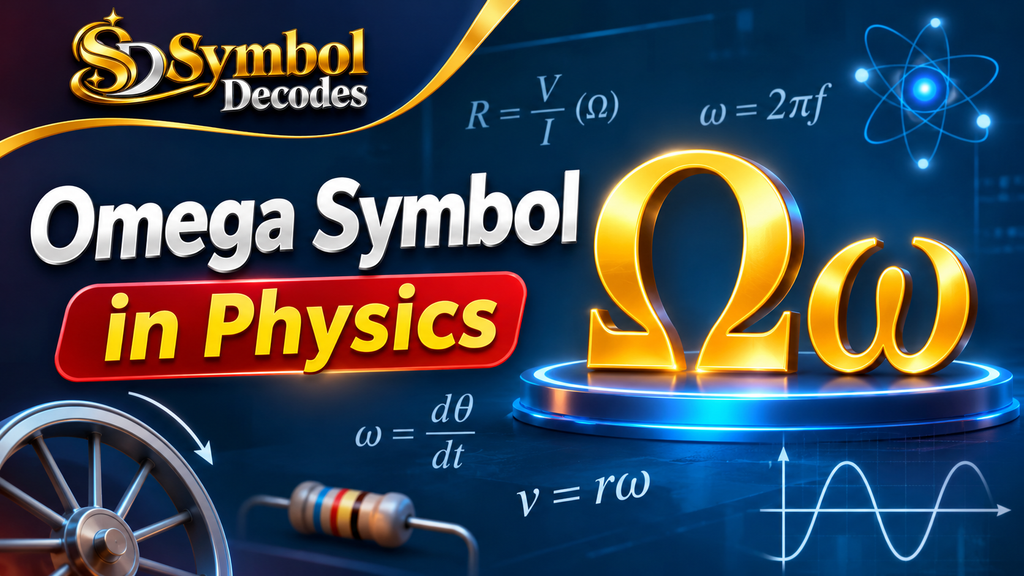
Omega is a significant symbol that is depicted by the Greek letter Omega (Ω). The letter is employed to depict numerous physical quantities, mathematical functions, and scientific phenomena in the domains of physics such as electricity, mechanics, rotation, waves, and many more. At times, the Omega symbol is employed for depicting angular velocity, angular frequency, resistance, or solid angle.
In order to understand how to employ the omega symbol in physics, it is essential to know about the uses of the omega symbol because the same Greek letter is used for denoting different things in different formulas. Omega in uppercase (Ω) and lowercase (ω) is used in physics equations, but it does not mean the same.
In this article, we will look into the omega symbol in physics, its definition, units, formulas, uses, examples, and the difference between uppercase and lower case Omegas.
What Is the Omega Symbol in Physics?
Omega is the 24th and the last letter in the Greek alphabet. There are two forms through which omega can be represented:
- Omega (Capital): Ω
- Omega (Small): ω
The two letters are used to symbolize different values when applied in the physics discipline. Depending on the subject, formula, or text in consideration, the letters have different uses and meanings.
For example, the capital omega (Ω) represents the ohm, the unit of electric resistance.
| Symbol | Name | Common meaning in physics |
|---|---|---|
| Ω | Capital Omega | Ohm (unit of resistance), solid angle |
| ω | Small Omega | Angular velocity, angular frequency |
| Ω (in some texts) | Capital Omega | Angular velocity or other defined quantities |
| Ωₘ | Omega sub m | Matter density parameter in cosmology |
| Ω₀ | Omega sub zero | A defined reference or initial parameter, depending on context |
The meanings of these symbols should always be understood from the equation in which they appear.
Uppercase Omega (Ω) in Physics
There are many uses of the uppercase omega (Ω) in the field of physics. The most common use of omega (Ω) is as a symbol representing the ohm, which is a measure of electrical resistance.
Nevertheless, omega (Ω) may represent a solid angle in three-dimensional space and various other physical values in equations that are specialized.
1. Omega (Ω) as a Symbol Representing Electrical Resistance (Ohm)
Omega (Ω) is the symbol that represents the ohm, the SI unit of electrical resistance.
Electric resistance refers to the opposition offered by an electrical element to the flow of electricity.
Resistance is determined according to Ohm’s law.
Formula:
Where:
- R = Electrical resistance
- V = Voltage (volts)
- I = Electric current (amperes)
SI unit:
For example, if a resistor has a voltage of 12 volts across it and carries a current of 2 amperes, its resistance is:
Therefore, the electrical resistance is 6 ohms.
2. Omega as a Symbol for Solid Angle
Upper-case omega (Ω) may also be used for a solid angle in geometry and physics.
A solid angle is a quantity that expresses the apparent size of an object seen from a specific viewpoint in 3D space. It is somewhat analogous to an angle in that it defines an area in space as opposed to just a direction.
Formula:
Where:
- Ω = Solid angle
- A = Area on a spherical surface
- r = Radius of the sphere
SI unit: Steradian (sr).
For example, solid angles are useful when studying light emitted by a lamp, radiation from a source, and the field of view of optical instruments.
3. Omega in Cosmology
The uppercase form of omega is also seen in cosmology, where it represents density parameters.
A density parameter is the ratio of the density of a specific element in the universe to its critical density.
Some common examples are:
- Ωₘ – Density parameter for matter
- Ωᵣ – Density parameter for radiation
- ΩΛ – Density parameter for dark energy
- Ωₖ – Density parameter for curvature
Lowercase Omega (ω) in Physics
The lowercase letter omega (ω) is commonly used in the areas of mechanics, oscillations, waves, and electronics.
There are two common applications of omega, angular velocity and angular frequency. They are similar to each other because they measure a rate of change relative to time but have different applications.
1. Omega as Angular Velocity
Angular velocity means the velocity at which an object moves in a circle around a fixed point or revolves.
Formula:
For instantaneous angular velocity:
Where:
- ω = Angular velocity
- θ = Angular displacement
- t = Time
SI unit: Radian per second (rad/s).
For instance, when a rotating fan revolves through several revolutions within a short time span, angular velocity determines how fast it is spinning.
The relationship between angular velocity and linear velocity is:
Where:
- v = Tangential linear velocity
- r = Radius of rotation
- ω = Angular velocity
This formula shows that the tangential velocity increases with the distance from the axis when angular velocity remains constant.
2. Omega as Angular Frequency
Angular frequency is another important application of lowercase omega.
It measures how rapidly the phase of a periodic motion or oscillation changes with time. It is closely related to ordinary frequency.
Formula:
Where:
- ω = Angular frequency
- π = Mathematical constant (approximately 3.14159)
- f = Frequency in hertz (Hz)
The SI unit is radian per second (rad/s).
For example, if a wave has a frequency of 50 Hz, its angular frequency is:
Therefore, the angular frequency is approximately 314.16 radians per second.
The International Union of Pure and Applied Chemistry (IUPAC) defines angular frequency as frequency multiplied by 2π.
Important Formulas of Omega in Physics
Omega appears in several important physics equations. The following table presents some commonly used formulas and their applications.
| Physics concept | Formula | Meaning |
| Angular velocity | ω = dθ / dt | Rate of rotational motion |
| Angular frequency | ω = 2 × π × f | Frequency expressed in angular units |
| Linear velocity | v = r × ω | Relationship between linear and angular velocity |
| Angular acceleration | α = dω / dt | Rate of change of angular velocity |
| Centripetal acceleration | a_c = r × ω² | Acceleration toward the centre |
| Simple harmonic motion | ω = √(k / m) | Natural angular frequency of an ideal spring-mass system |
| LC circuit resonance | ω₀ = 1 / √(L × C) | Ideal resonant angular frequency |
These formulae are employed in various fields in physics; therefore, it is necessary to understand what omega means before plugging in the values.
Difference Between Uppercase Omega (Ω) and Lowercase Omega (ω)
Even though the two letter forms come from the same Greek letter, they differ in appearance and usage in science.
| Basis | Uppercase Omega (Ω) | Lowercase Omega (ω) |
| Appearance | Ω | ω |
| Name | Capital Omega | Small Omega |
| Electrical applications | Symbol for ohm | Used in AC frequency and reactance equations |
| Mechanics | Used for some rotational quantities | Commonly represents angular velocity |
| Wave physics | Used in specialized contexts | Represents angular frequency |
| SI unit | Ohm (when representing resistance) | Usually rad/s for angular velocity or angular frequency |
Important: The letter alone does not determine the physical quantity. Always check the surrounding formula and the notation defined by the author.
Applications of the Omega Symbol in Different Branches of Physics
The omega symbol has uses in a number of scientific fields. Some of the areas that employ omega include:
1. Classical Mechanics
In classical mechanics, lowercase omega is frequently employed in the discussion of rotational motion.
It assists in finding out the angular speed of items such as wheels, fans, engines, turbines, etc.
2. Electricity and Magnetism
In electrical physics, uppercase omega (Ω) stands for electrical resistance, while lowercase omega (ω) is applied in AC circuits.
For example, inductive reactance is calculated using:
Where:
- Xₗ = X sub L = Inductive reactance
- ω = Angular frequency
- L = Inductance
3. Wave Physics
Angular frequency is an important quantity in the study of sound waves, electromagnetic waves, and periodic oscillations.
A wave can be represented using the equation:
Where:
- A = Amplitude
- ω = Angular frequency
- t = Time
- φ = Phase constant
4. Quantum Physics
In quantum physics, omega symbolizes angular frequencies, transition frequencies, and other variables as described in some theory model.
For instance, there could be a frequency of the difference in energy between two quantum states.
5. Cosmology and Astrophysics
There are applications of omega symbols in cosmological theories that express the proportions of matter, radiation, dark energy, and curvature in space.
Such quantities make it easy for scientists to analyze the structure and evolution of the universe.
How to Calculate Omega in Physics: Solved Examples
Formulas become much clearer when omega is explained through numeric problems.
Example 1: Calculation of Angular Velocity
Problem: The wheel makes 10 rotations in 5 seconds. Find its angular velocity.
Solution:
Given:
- Number of revolutions = 10
- Time = 5 seconds
Angular displacement:
Using the formula:
Therefore, the angular velocity is approximately 12.57 rad/s.
Example 2: Calculate Angular Frequency
Question: A sound wave has a frequency of 100 Hz. Find its angular frequency.
Solution:
Given:
Formula:
Substituting the values:
Therefore, the angular frequency is approximately 628.32 rad/s.
Example 3: Calculate Electrical Resistance
Question: An electrical device operates at 24 volts and draws a current of 3 amperes. Calculate its resistance in ohms.
Solution:
Given:
- Voltage = 24 V
- Current = 3 A
Using Ohm’s law:
Therefore, the electrical resistance is 8 ohms.
Why Is the Omega Symbol Important in Physics?
The importance of the omega symbol lies in the fact that it gives scientists an opportunity to mathematically denote various physical quantities.
Some reasons why the symbol omega is important can be listed as follows:
- It helps to simplify scientific equations due to using Greek symbols;
- It explains rotary movements since angular velocity explains the movements of a rotating object;
- Angular frequency helps to conduct wave calculations;
- The symbol Ω denotes the ohm – the unit of electrical resistance;
- Parameters of omega help mathematicians to create mathematical models of the universe;
- Omega equations can be used in electrical engineering.
Mistakes Students Often Make in Using Omega
Students often mistake uppercase omega with lowercase omega due to the similar appearance of those symbols which belong to the same Greek letter.
The following mistakes should be avoided:
- Mistaking Ω (ohm) and ω (angular frequency);
- Mistaking hertz for rad/s in denoting angular frequency;
- Failure to multiply ordinary frequency by 2π;
- Mistaking angular velocity for linear velocity;
- Believing that uppercase omega means electrical resistance only;
- Using an equation without knowing the meanings of all variables used there.
It is important to know that the scientific context defines the meaning of omega.
Omega Symbol in Physics: Quick Reference Table
| Information | Details |
| Symbol name | Omega |
| Greek alphabet position | 24th |
| Uppercase symbol | Ω |
| Lowercase symbol | ω |
| Electrical unit | Ohm |
| Angular velocity symbol | ω (commonly) |
| Angular frequency symbol | ω |
| Solid angle symbol | Ω |
| SI unit of resistance | Ohm (Ω) |
| SI unit of angular velocity | rad/s |
| SI unit of angular frequency | rad/s |
| Common applications | Mechanics, electricity, waves, cosmology |
Final Words
The omega sign in physics is a very significant scientific notation employed in mechanics, electricity, wave physics, and cosmology. Uppercase omega (Ω) is very popularly known to represent the ohm, while lowercase omega (ω) is popularly known to be used as angular velocity and angular frequency.
Having an idea about the use of these signs in physics will make your work easier when handling physics problems. No matter whether it is a rotational problem, electrical problem, oscillation, or wave problem, knowing the use of omega in physics will help you learn physics.
Frequently Asked Questions
The omega symbol represents different physical quantities depending on its form and context. Lowercase ω commonly represents angular velocity and angular frequency, while uppercase Ω represents the ohm, the SI unit of electrical resistance.
Ω is uppercase omega, commonly used for electrical resistance units and solid angles. ω is lowercase omega, generally used for angular velocity and angular frequency.
The SI unit depends on the quantity represented. Angular velocity and angular frequency are expressed in radians per second (rad/s), while electrical resistance is measured in ohms (Ω).
Yes. Uppercase Ω represents the ohm, the SI unit of electrical resistance. Lowercase ω is also used in alternating-current equations to represent angular frequency.
In rotational motion, lowercase omega (ω) commonly represents angular velocity, which measures how quickly an object changes its angular position over time.
Also read: Tangled Sun Symbol: Meaning, Origin, and Significance